
Your hotel is photographed in the lobby. It’s reviewed at 3 am
The most valuable luxury material in hospitality can't be photographed, touched or ordered from a catalogue. It can only be designed: silence.
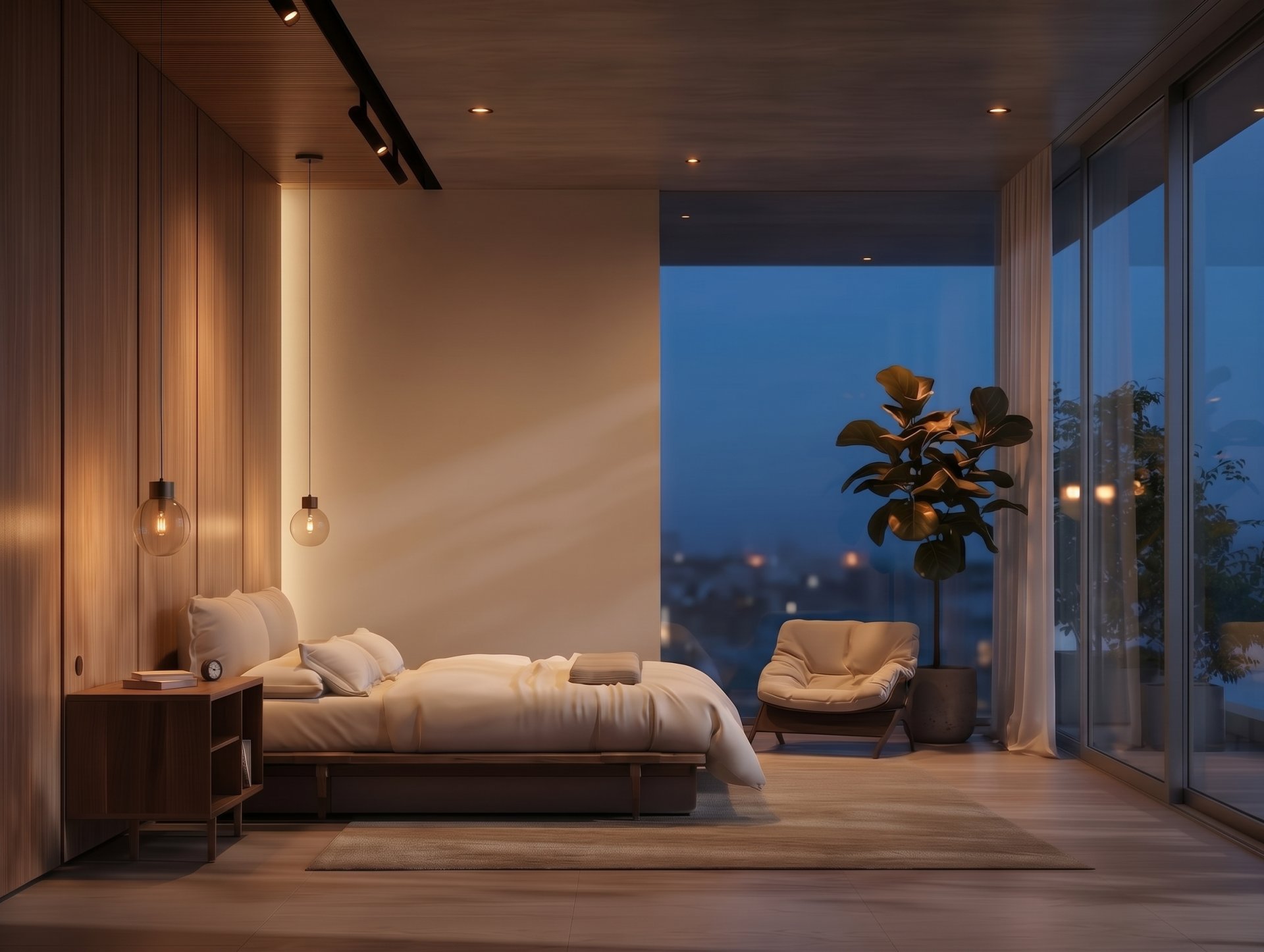
Every hotel is two hotels
Every hotel is really two hotels sharing one address.
The first is the daytime hotel. This is about the lobby, the terrace, the restaurant, the pool. It’s the hotel of brochures, booking-site galleries and Instagram. It’s where owners, understandably, spend most of their design attention, because it’s where first impressions are made.
The second is the night-time hotel. It exists roughly between midnight and six. It’s made of the neighbour’s television, the lift humming on the other side of the wall, the door at the end of the corridor that slams at 1:30am, the air conditioning that wakes up every twenty minutes, and the thin blade of corridor light under the door.
The daytime hotel sells the room. The night-time hotel often writes a negative review.
What guests actually complain about
Ask hoteliers what guests complain about and you will always hear the same two words: cleanliness and noise. In September, CNN reported the view of hotel software and consulting firm ProStay that noise is now guests’ top concern after cleanliness and that, with sleep increasingly (and correctly) treated as part of health, guests see a good night as a core part of what they are paying for.
There is a crucial difference between those two complaints. Cleanliness is an operations problem. You can fix it on Monday morning with better training, better checklists, better staffing. Noise is, for the most part, an architecture problem. Guests will always make noise but buildings should decide how much of it travels around. Once the walls, floors, doors, ducts and plans are built, no amount of staff training will move a lift shaft away from a headboard.
Why the night is a revenue line
For years a bad night was a private disappointment. Today it is public, searchable and, especially in Italy, increasingly regulated.
Since 7 April 2026, Law 34/2026 has set specific rules for online reviews of Italian restaurants and tourist accommodation. A lawful review must be written by someone who actually used the service, within 30 days. Buying and selling reviews is explicitly banned, and reviews older than two years are no longer considered current. In plain terms, your score will increasingly reflect the building you actually operate and the nights people actually spent in it.
And that score has a price. In a widely cited study for Cornell’s Center for Hospitality Research, Chris Anderson found that a hotel improving its review score by one point on a five-point scale could raise its price by 11.2% and keep the same occupancy. The same study linked a 1% improvement in online reputation to an increase of up to 1.42% in revenue per available room. The data are from 2012 and the United States; the mechanism has hardly weakened since.
Closer to home, researchers at Politecnico di Torino surveyed guests in Italian hotel rooms about indoor comfort. Their willingness to pay for excellent comfort conditions came to about 14% of the room rate. That’s a stated preference, people tend to say more than they eventually pay, so treat it as an upper bound. But it points the same way as Cornell’s market data: comfort is not a cost centre. It’s pricing power, collected the next morning.
What silence is made of
Luxury used to mean more: more marble, more gold leaf, more square metres. Increasingly it means less: less noise, less glare, fewer interruptions. The good rooms may impress you when you walk in, but then the best ones should disappear when you close your eyes.
Silence is not a single product you can specify. It is the sum of many small decisions, most of them invisible. When we design a hotel, we walk through the night before we walk through the day:
- The door. At 1 a.m., every sound travels. That is why weight, drop seals, and a soft-close mechanism are needed to turn a slam into a click.
- The corridor. Soft floors and absorptive ceilings “swallow” footsteps and wheeled suitcases. Staggering doors, rather than lining them up face to face, keeps one room’s conversations out of the next.
- The bed wall. It should never back onto a lift shaft, a service riser or the neighbour’s bathroom. Bathrooms and wardrobes make excellent acoustic buffers, if the plan puts them in the right place.
- The air. Guests notice air conditioning in two ways: when it’s too loud, and when it keeps switching on and off. The World Health Organization notes that low-frequency noise, such as that from ventilation systems, can disturb rest and sleep even at low levels. Quiet, steady systems are an engineering choice made long before the first guest arrives.
- The dark. Real blackout, no blade of light under the door, and a low, warm light that guides you to the bathroom without turning the room into an operating theatre.
- The materials. Here is the happy coincidence of hotel design: many of the materials that absorb sound including wool, timber, heavy textiles, upholstered headboards, are also the materials that feel like luxury. Done well, the quiet room and the beautiful room are the same room.
What hospitals taught us about the night
ATI Project has ample experience also in healthcare architecture, and in a hospital, a bad night isn’t a bad review but a harder day of recovery. Italian building law reflects the difference: it requires hospitals to be better insulated against noise than hotels.
That background gave us a habit we bring to every hospitality project: design the night first, then the day. In the requalification of Toscana Resort Castelfalfi, in the Tuscan hills, the view was the first amenity. The quiet that lets you enjoy it was the second.
A test you can run tonight
You don’t need an acoustic consultant to find out whether your hotel has a night-time problem.
Ask your general manager for the room with the most noise complaints. Every hotel has one, and every general manager knows its number. Sleep in it. Keep a notebook on the bedside table and write down every sound, every light and every time you wake up.
Then read your last hundred reviews and search for “noise”, “rumore”, “thin walls”, “Lärm” and “bruit”.
By morning you’ll have the most honest design brief your hotel has ever received, written by the building itself.
The luxury nobody photographs
Your lobby will always get the photographs. And it should!. But your rooms get the reviews, and since April, those reviews are harder to fake and easier to trust.
Silence doesn’t photograph well. It reviews beautifully.

Appendix
References
1. CNN Travel (3 September 2026). “Noise is a top guest complaint but many hotels can't fix it.” (https://edition.cnn.com/2026/09/03/travel/noise-hotels-complaints-solutions)
2. Legge 11 marzo 2026, n. 34 — Legge annuale sulle piccole e medie imprese, Capo IV “Lotta alle false recensioni”. Gazzetta Ufficiale n. 68, 23 March 2026.
3. Anderson, C. K. (2012). The Impact of Social Media on Lodging Performance. Cornell Hospitality Report, Cornell Center for Hospitality Research, November 2012.
4. Buso, T., Dell'Anna, F., Becchio, C., Bottero, M. C., & Corgnati, S. P. (2017). Of comfort and cost: Examining indoor comfort conditions and guests' valuations in Italian hotel rooms. Energy Research & Social Science, 32, 94–111.
5. World Health Organization (1999). Guidelines for Community Noise (B. Berglund, T. Lindvall et al., eds.). Geneva: WHO.